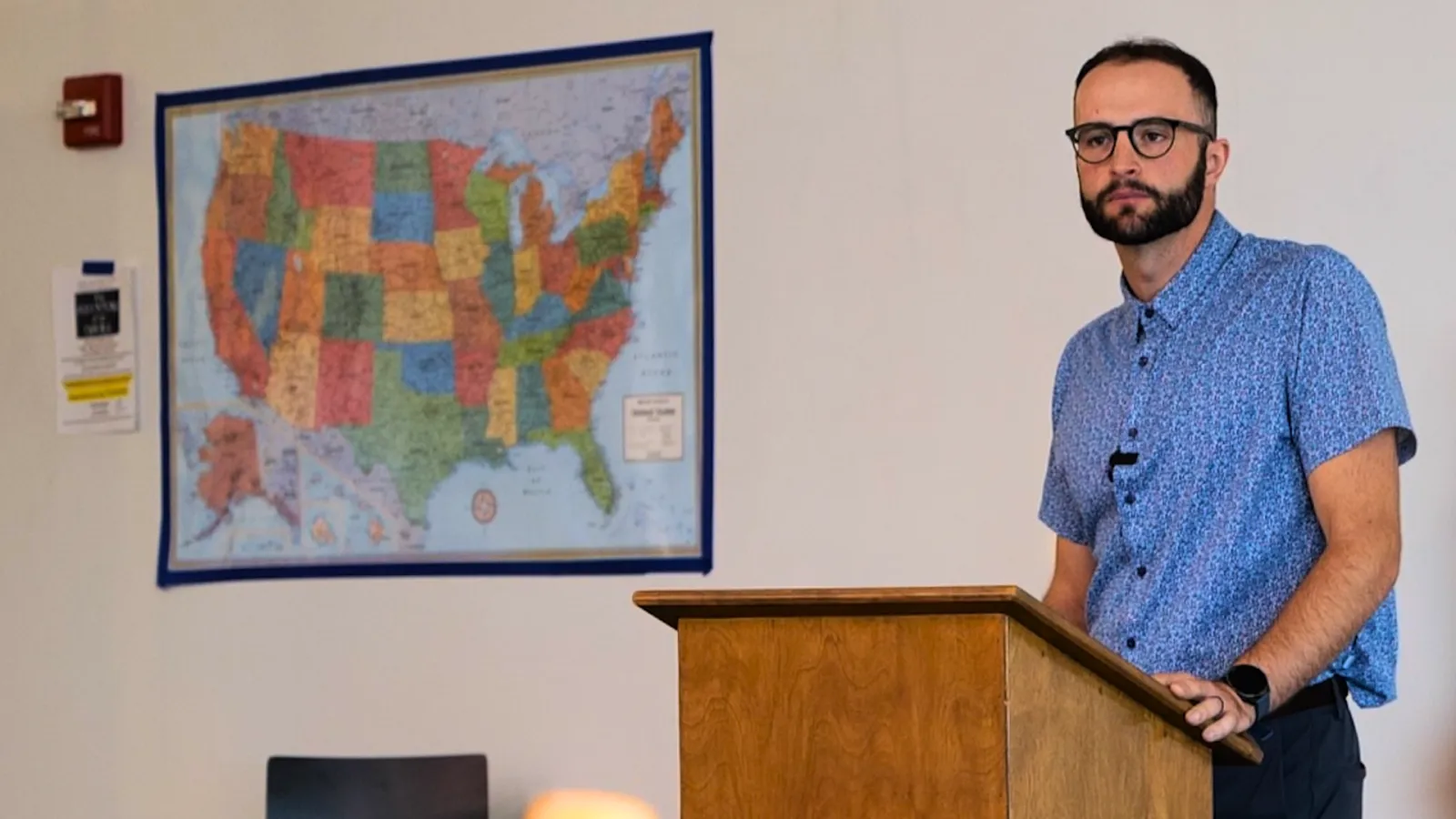

On the upper floor of Legacy High School in Bismarck, students file into Landen Schmeichel’s classroom on the third day of school for the new year.
I am excited to have been invited to his room, which is filled with symbols of big ideas from American history, to observe a U.S. History class.
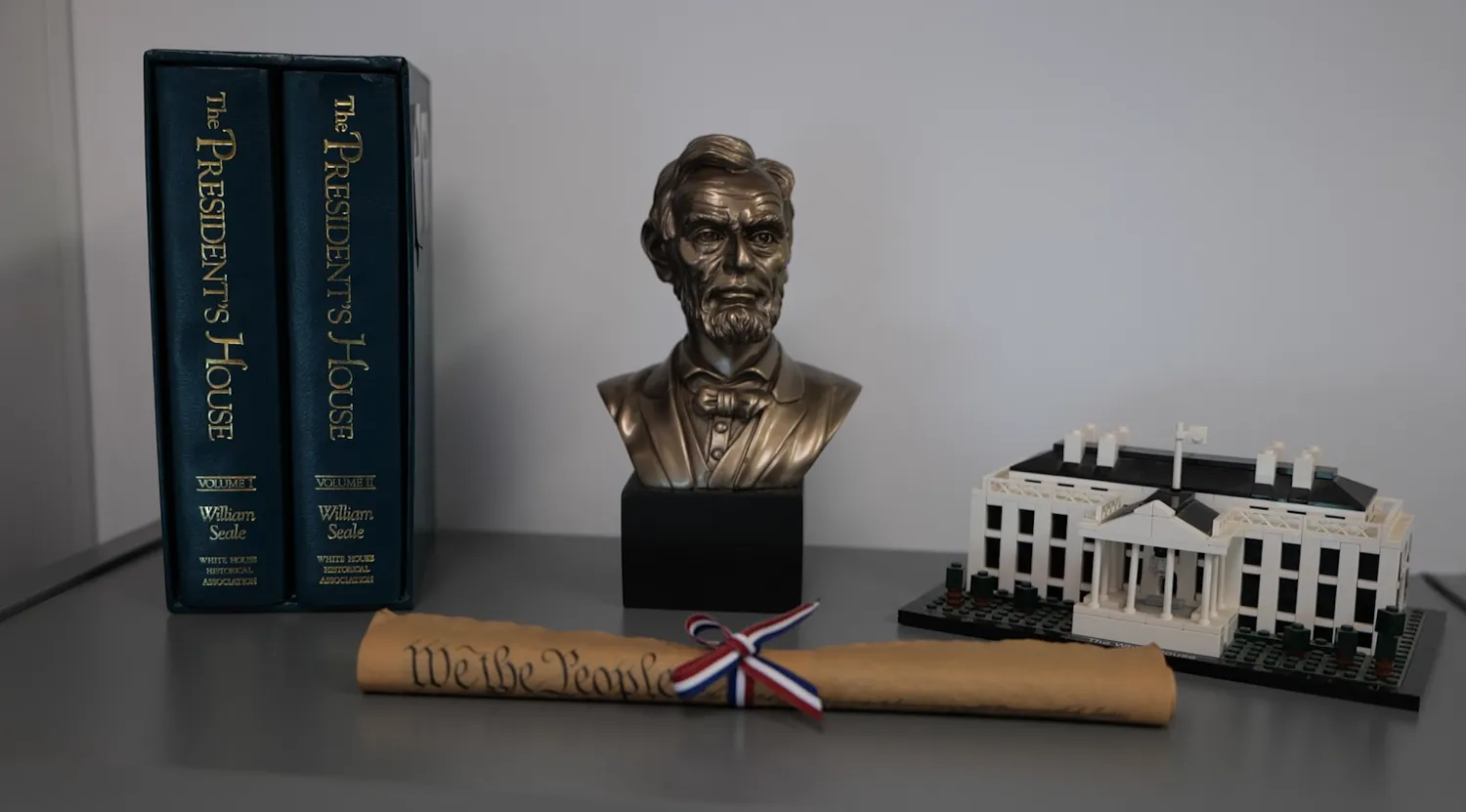
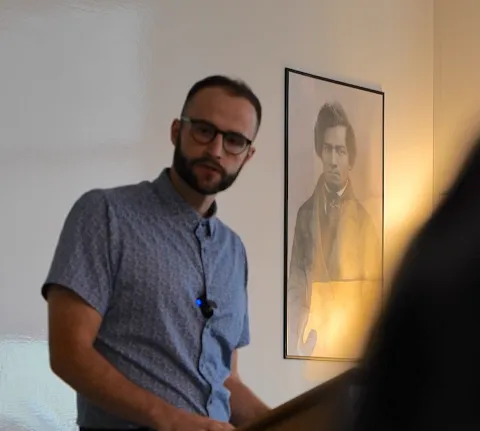
Behind Mr. Schmeichel’s desk, there sit several totems of American freedom: a bronze bust of Abraham Lincoln accompanied by a Lego set of the White House and a copy of the U.S. Constitution. Under the clock by the door, a portrait of John Fitzgerald Kennedy, perhaps a reminder of what students can do for their country. A large portrait of Frederick Douglass, prominently positioned at the whiteboard next to the room’s brightest lamp, to my mind a representation of the visionary abolitionist’s bright ideas that would influence a nation.
As the students settle in, surrounded by larger-than-life figures whose big ideas changed the world, Mr. Schmeichel introduces students to the pedagogical core of his approach to U.S. History: a lecture about what history is. Not just names and dates to be memorized, but rather a collection of big ideas that animated those recognizable names on those famous dates.
“History is less about memorizing important dates and people, and more about understanding how facts can create cogent arguments,” Schmeichel said. “The better our arguments are, the more we can realize success; the more we can learn from one another about how those historical experiences inform the way we are today. It helps us to be more caring, more competent and to have better thriving communities.”
All of that begins with students engaging with primary sources: the speeches, letters, private diaries, public interviews, tweets and other documents that have shaped American history for the past 250 years.
“When Frederick Douglass, the child of his enslaver and his mom who was enslaved, says that ‘America is fundamentally good,’ when he champions the American Constitution as a ‘glorious liberty document,’ yet he says America is also one of the most hypocritical nations in the history of humankind, that’s not Landen Schmeichel insisting that Frederick Douglass is right or wrong, that’s Landen Schmeichel engaging students with the arguments of the past. I’m asking them questions about their thoughts, their reactions and their connections to what Frederick Douglass had to say in 1852,” he said.
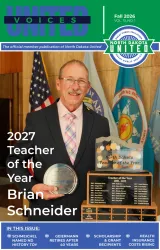
That philosophy is, in part, one of the things that earned Schmeichel the 2025 Gilder Lehrman North Dakota History Teacher of the Year, a coveted award in the world of social studies education, which comes with a cash prize, classroom resources for students and graduate-level coursework provided by Gettysburg College, which can be used as professional development credits toward licensure renewal.
“I was really honored and privileged to receive that award. But it all comes back to students,” he said. “How do we deliver experiences for learners in our classrooms that don’t just equip them to be good workers, but make them into citizens that are going to contribute to their community and their country?”
North Dakota History Teacher of the Year — that’s a big deal, a once-in-a-career type of award. But the 2025-26 school year was a big one for Schmeichel, and as such, ND History Teacher of the Year was not the only major award he received. He was also recognized as the Bismarck Mandan Chamber of Commerce Secondary Teacher of the Year, one of five educators from elementary to college-level between the two cities to receive such an award, and one that represented a full-circle moment in his career.
“When I started out in education, I was an instructional aide at Wachter Middle School,” Schmeichel said. “A teacher I worked closely with, Jeramie Schafer, won that award that year. And I remember thinking, ‘When I become a teacher, I’m going to seek out teachers who win that award and learn from them.’ So, to receive that award was not only surprising, humbling, amazing — it just took me back to where I started in education and wanting to be the teacher that delivered for every student.”
For Schmeichel, that every student bit is really important. He is a fierce public-school advocate. He believes in adequately funding public schools and providing great public education for all students.
That passion for public education is due, in part, to his unique educational experience in childhood. He struggled academically in early elementary school. At that point, his parents decided to homeschool him.
“The experience that I had [in public education] wasn’t working,” he said. “My advocacy for public education really stems from my mom’s insistence that my education challenged me, and that brought me to a level that she believed I could be at. But it’s now my insistence that every person deserves a shot, every person deserves a chance. I believe that students who are like me, who came from a background where resources were generally there, they matter. But students who don’t come from that background, they matter too.”

Part of that mission of strengthening public schools is advocacy on behalf of his fellow educators. A former Student-NDU president and government relations chair for the Bismarck Education Association, in 2025, he led Bismarck Education Association’s negotiations team. Together, they delivered wins for their colleagues around the district.
“I was amazed at the process of receiving feedback from my colleagues, writing goals based on that feedback that would allow us to equip educators with what they need,” Schmeichel said. “Serving on that team eclipsed all my other experiences in [local unions I had been a part of].”
Some of those wins included clearing up contract language and securing raises with no additional insurance monies needed, despite a meager increase for K-12 education from the state Legislature. Despite the wins, he knows something needs to change at the state level if public education in North Dakota can continue to thrive.
“Funding public education is about ensuring that our communities have enough support to give educators what they need in order to support long-term human flourishing,” he said.
Quote byLanden Schmeichel, 2025 Gilder Lehrman North Dakota History Teacher of the Year

Back in his classroom on the third day of school, Schmeichel’s introduction to big ideas is a hit. It generates insightful conversations among students about what patriotism means. After comparing lecture notes, everyone packs up for their second period class. As they exit, the 2025 North Dakota History Teacher of the Year stands at the door and delivers fist bumps and high fives, thanks them for their attention, and wishes them a good day.
One can’t help but reflect on what Mr. Schmeichel just spent the hour doing. Today, he presented his students with the tools for success, which they will use to strengthen their communities with civic engagement, and which will ultimately lead to a stronger nation.
As I shake his hand and leave the third-floor classroom, I glance up at JFK and can’t help but think to myself, “Landen Schmeichel doesn’t have to wonder what he can do for his country. He’s already doing it.”